Written by @hoops_talk_
introduction/Restricted fa analysis and editing by gregory spicer
08/06/2025
Restricted free agency is one of the most well-known yet misunderstood dynamics in the NBA. Everyone knows that some players are restricted, but what does this mean besides that they will probably remain with their organization?
RFA triggers when a team sends a player a qualifying offer at the end of a rookie OR 3-4 year contract. A qualifying offer is a chance for the player to stay on the team for one more season, prove themselves, and then enter UNrestricted free agency the following offseason. The amount of the deal is decided by the CBA and usually well under the value of the player. The only time someone would accept this contract is if they trust their health and really want to be an unrestricted free agent.
This offseason, four premier talents across the NBA find themselves in this situation. On paper, each player is worth the contract they seek ($30 million AAV), but they (teams and players) each have minor issues that prevent the deals from getting done.
- Josh Giddey has only become a competent shooter in the last few months of 2024-25. His streaky jumper at the PG position raises questions about his ceiling. The Bulls could have over $100 million in Cap Space next summer, and want to retain as much room as possible after the Giddey negotiations.
- Jonathan Kuminga is always great when he plays, but is yet to earn the trust of head coach Steve Kerr. Giving him what he’s worth would prevent the Warriors from using their tax MLE in free agency to sign another role player while also requiring more trust from Kerr to get their money’s worth.
- Cam Thomas is undoubtedly a $30 million dollar talent, but hasn’t proven his ability to lead a winning team. On a squad with FIVE first-round picks, the Nets don’t want to cough up their money for a player who will require 20+ shots.
- Quentin Grimes had an awesome half-season with Philadelphia, but the sample size was small. It’s hard to commit over $25 million based on 28 games. On the Sixers’ side, they already have a young, great backcourt (Maxey and McCain), which makes the deal even less enticing.
Restricted free agency has many more factors than your usual off-season deal. Teams are considering future assets and controllability while still trying to get the cheapest deal possible. On the players’ side, they can only work with what they are given. A player like Kuminga, who has outside suitors, may scrounge up a better deal via a bidding war. Giddey, who doesn’t have similar options, will be forced to either accept Chicago’s terms or prove himself with the qualifying offer.
With that, here is @HOOPS_TALKS_’s breakdown of the headline players in the restricted group.
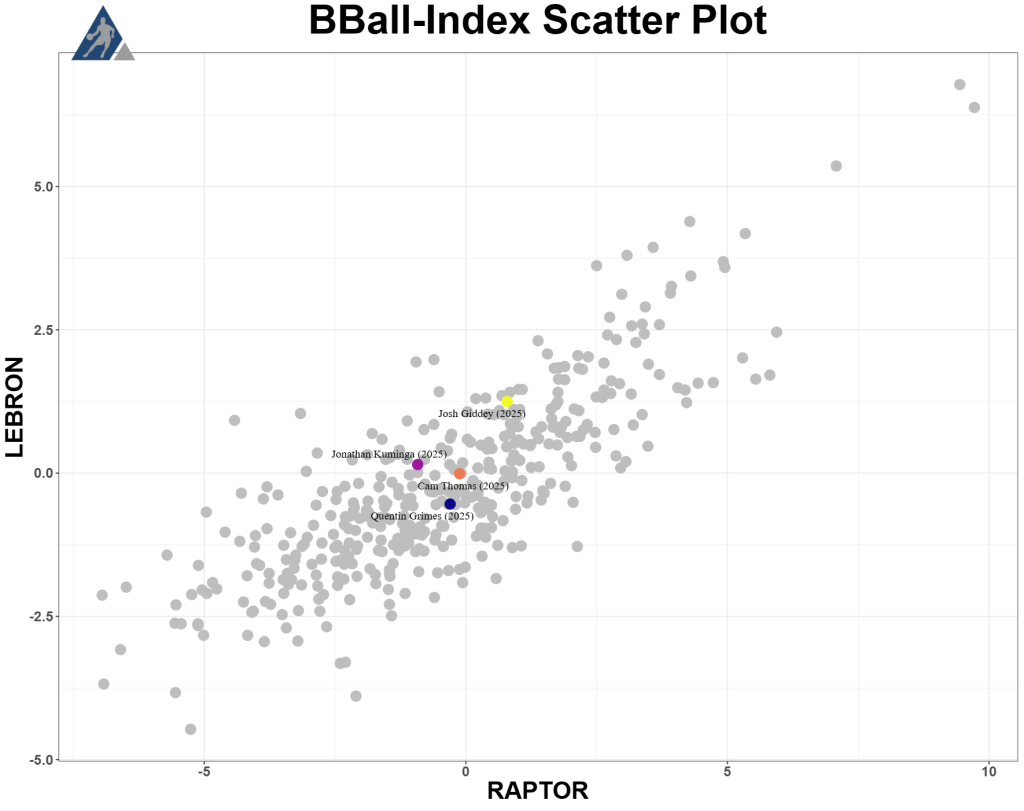
Josh Giddey has balled out since being traded to the Chicago Bulls before the 2024/25 season. From a statistical point of view, Giddey improved by putting up 14.6 PPG, 8.1 RPG, and 7.2 APG while shooting the ball efficiently (57% TS). However, I don’t think he’s worth the $30 million per year contract he seeks from the Bulls. His value does set him above the $20 million per year that he was offered, but I believe that Giddey and the Bulls should agree on a 4-year $100 million contract. $25 million per year feels like the right amount for the 6’8 guard. I’d also love to see Giddey playing on a contender again, but that all depends on the Bulls’ direction going forward. (The chart details advanced impact metric values of each player in 2025)
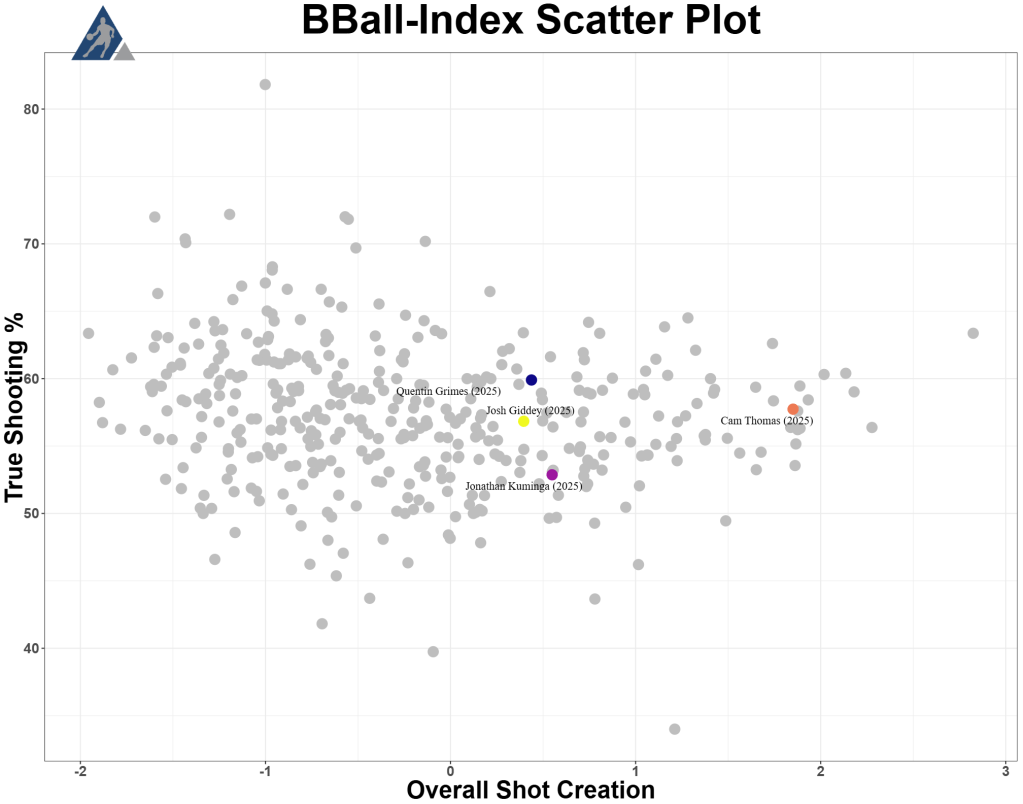
Jonathan Kuminga of the Warriors is another restricted free agent who finds himself in an uncomfortable situation. The 7th overall pick in the 2021 NBA Draft is reportedly seeking $30 million per year on his next contract, but the Warriors are not willing to oblige. Kuminga’s situation has drawn the most attention of the four players, after the Warriors had multiple offers in the $20 million range rejected. The Kings and Suns, his other primary suitors, have been monitoring the negotiations and are attempting to acquire him via sign-and-trade. Despite this, the indecisive Warriors have rejected several trade packages from both teams in search of an unprotected first-round pick. Unlike Josh Giddey, I believe Kuminga needs a change of scenery. GIVEN HEAD COACH STEVE KERR’S CONSISTENT benching of Kuminga in big moments, he should join a team that can truly value him. A sign-and-trade in the $20–25 million per year range could get it done. (graph details advanced offensive metric values for each player)
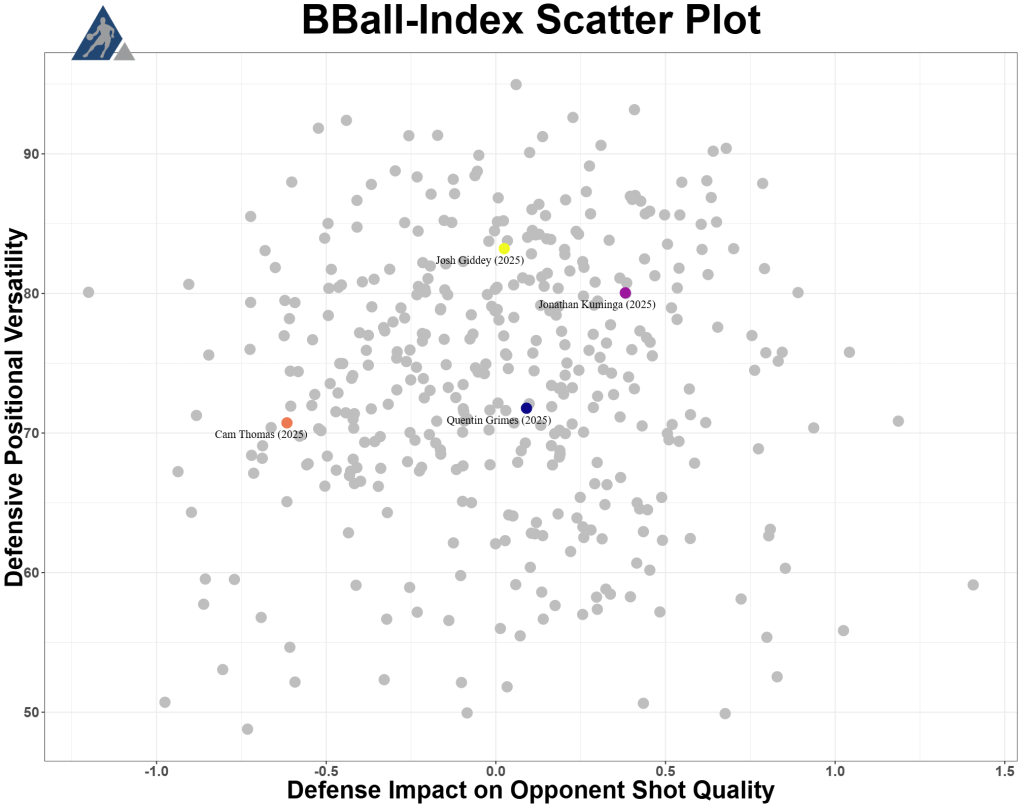
Cam Thomas, the starting shooting guard for the Brooklyn Nets, is also a restricted free agent. Like Josh Giddey, he wants to stay with his current team on a new contract, but negotiations have been difficult. The Nets have only offered Thomas a two-year, $28 million deal. It might be an unpopular opinion, but I believe the 6’4” guard is worth significantly more. He averaged 24 PPG last season and is only 23 years old. While his playmaking still needs work, he’s a bucket-getter and far from his prime. The Nets, who have the cap space, should increase their offer. I think he deserves something in the $20–25 million per year range, similar to what Kuminga is worth. (Graph details advanced defensive metrics for each player)
Quentin Grimes has been a revelation for the Philadelphia 76ers, even if their 2024–25 season was disappointing as a whole. The guard boosted his scoring average from 10.2 PPG to 21.2 PPG after being traded from the Dallas Mavericks. The 25-year-old is seeking a $25 million per year contract, but the Sixers refuse to give in. I think Philadelphia made the right decision by holding off, considering his scoring surge came largely due to increased minutes on an injury-depleted roster. Grimes hasn’t yet shown that he’s worth $25 million annually, so a short-term/prove-it deal might be a better option. Something like a two-year, $30 million contract makes more sense.
FOr More analysis like this, follow @hoops_talk_ on instagram
 Basketball Operations Brief
Leave a comment