Gregory spicer – nba cup – dec. 19, 2025
The NBA Cup Championship was played on Tuesday, and it gave us one of the most exciting matchups we’ve seen this season. Two reasonably healthy, stacked teams competing on a big stage. Part of what made this game so interesting was both the differences and similarities between the two rosters.
The New York Knicks and San Antonio Spurs are contending, but they have notable differences in how their teams are built and where they are on their respective timelines. With both organizations looking to make a deep playoff run, reaching the NBA Cup Championship is a strong early indicator.
Where Are These Teams on Their Timelines?
What was fascinating about this matchup is that you had two teams with the same goal, at the same place, but on completely different timelines. The Spurs are just beginning their run of success under French phenom Victor Wembanyama. After missing the playoffs for six consecutive seasons, they’ve regained their status as a Western Conference powerhouse.
The Knicks, on the other hand, have made the playoffs in four of the last five seasons and brought in a new coach, Mike Brown, this offseason in hopes of taking the next step. In his first year in New York, Brown is looking for success wherever he can find it – including the NBA Cup.
Ultimately, the Knicks’ urgency and desperation for success prevailed. Brown needed the win to establish himself with fans and ownership. Superstars Jalen Brunson and Karl-Anthony Towns needed to validate themselves as championship-level cornerstones, and New York’s role players – many of whom have been discussed in trade rumors – legitimized their value.
On the Spurs’ side, they are younger and had far less to lose, which may explain their fourth-quarter struggles. They were outscored 36-19 in the final frame as their inexperience showed. Still, playing in this game was incredibly valuable for their young core. Wembanyama has yet to play in the NBA playoffs, but he already has “big-game” experience from the 2024 World Cup Finals against the U.S. and now NBA Cup Championship appearance. That exposure to high-stakes competition will almost certainly benefit him in the future – an advantage most young players don’t have.
How the Knicks Are Built
Both teams are built around a point guard / center dynamic duo. That’s largely where the similarities end.
For the Knicks, everything starts with Jalen Brunson. Despite his smaller stature, he’s one of the most prolific scorers in the league, averaging nearly 29 PPG on over 60% true shooting. He also shoots 38% from three and owns a +5.5% FG%+ (a new analytic combining field-goal percentage with shot difficulty, broken down HERE on the B.O.B.).
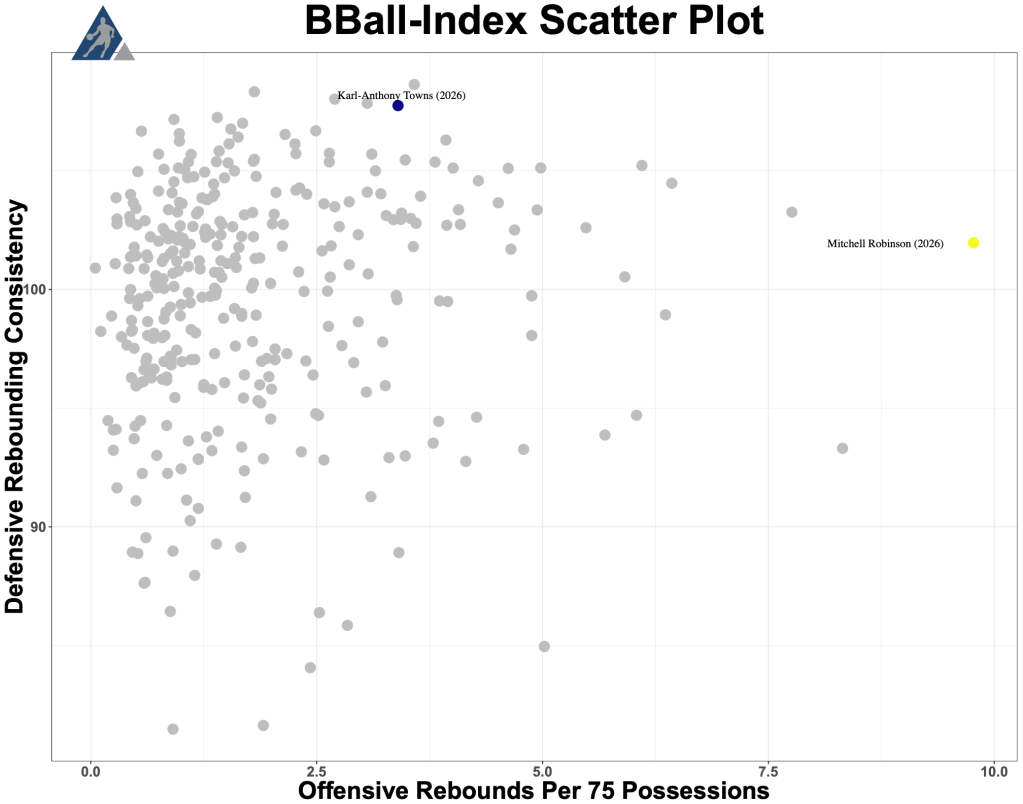
New York paired Brunson with All-Star center Karl-Anthony Towns. The former Timberwolf is widely considered the best shooting big man of all time and remains an elite scorer and rebounder. He averages 22 points and 12 rebounds while being highly efficient (61% TS%) and effective on the glass (4.0 contested rebounds per game).
The glaring weakness of this Knicks team is defense at key positions. Brunson (78.7% DFG%), at a generous 6-foot-2, is an easy mismatch. Towns (57% DFG%) is no rim-stopper either. The Knicks counter this by surrounding their offensive stars with defensive specialists who, when locked in, can make life miserable for opposing offenses.
OG Anunoby and Mikal Bridges headline that group. While labeled as “role players,” both are clearly valued above that tier – OG is on a five-year, $212 million extension, and the Knicks traded five first-round picks to acquire Bridges.
In return, the two wings provide elite perimeter defense, floor spacing, and reliable shot-making.

After those four, the Knicks’ financial flexibility is limited. They rely on a thin bench and hope for overperformances from cheaper contracts. Two of those players were on display in the NBA Cup Championship: Mitchell Robinson and Tyler Kolek.
Robinson still earns a solid $15 million annually, but when healthy, he fills a massive void. He allows Brown to experiment with twin-tower lineups alongside Towns or can serve as an elite sixth man. His rebounding and defense are his specialties, highlighted by a ridiculous 61% contested rebound rate. In the Cup Final, he grabbed 15 rebounds (10 offensive) and played outstanding defense on Wembanyama.
Kolek’s value, meanwhile, is trending up. His Cup Final performance was a breakout moment. On a $2 million contract, the Knicks’ NBA Cup win already makes him a net positive financially when accounting for prize money, merchandise sales, and future ticket demand. He’s now recorded back-to-back 10+ point games and recently notched a double-double against the Pacers. Whether this level of play is sustainable remains to be seen, but he has clearly earned a spot in the rotation moving forward.
How the Spurs Are Built
San Antonio boasts a young, exciting roster that has clicked early this season. Like the Knicks, they rely on a PG/C star pairing – but everything revolves around their crown jewel, Victor Wembanyama.
The 2025 All-Star has taken another leap this season, and if he stays healthy, the sky is truly the limit. His combination of 7-foot-5 size and guard-level skill allows him to dominate both ends of the floor. Outside of minor concerns about strength and durability, Wembanyama has no real weaknesses.
He’s an elite scorer (25+ PPG, 61% TS%, 35% from three) and a defensive powerhouse, holding opponents to nearly 11% below their average FG% when he’s the primary defender (-10.7 DIFF), along with 3.5 blocks per game. He also takes on some ball-handling duties and is a dominant lob threat. That’s still only scratching the surface of how absurd he is – but you get the idea.
To give Wemby another star, the Spurs acquired De’Aaron Fox from Sacramento at last year’s trade deadline, sending back four first-round picks and multiple quality players. At the time, the move made sense. However, unexpected lottery luck landed them Dylan Harper, the highly regarded No. 2 overall pick point-guard.
Fox has been excellent in San Antonio (23 PPG, 60% TS%, 16.5 assist points created), but the guard rotation is now crowded with Fox, Harper, and former Rookie of the Year Stephon Castle.
Early-season results have eased many concerns, though. Coming into the year, I questioned whether a three-guard lineup – with Fox and Harper undersized and no elite shooters – could properly support Wembanyama.
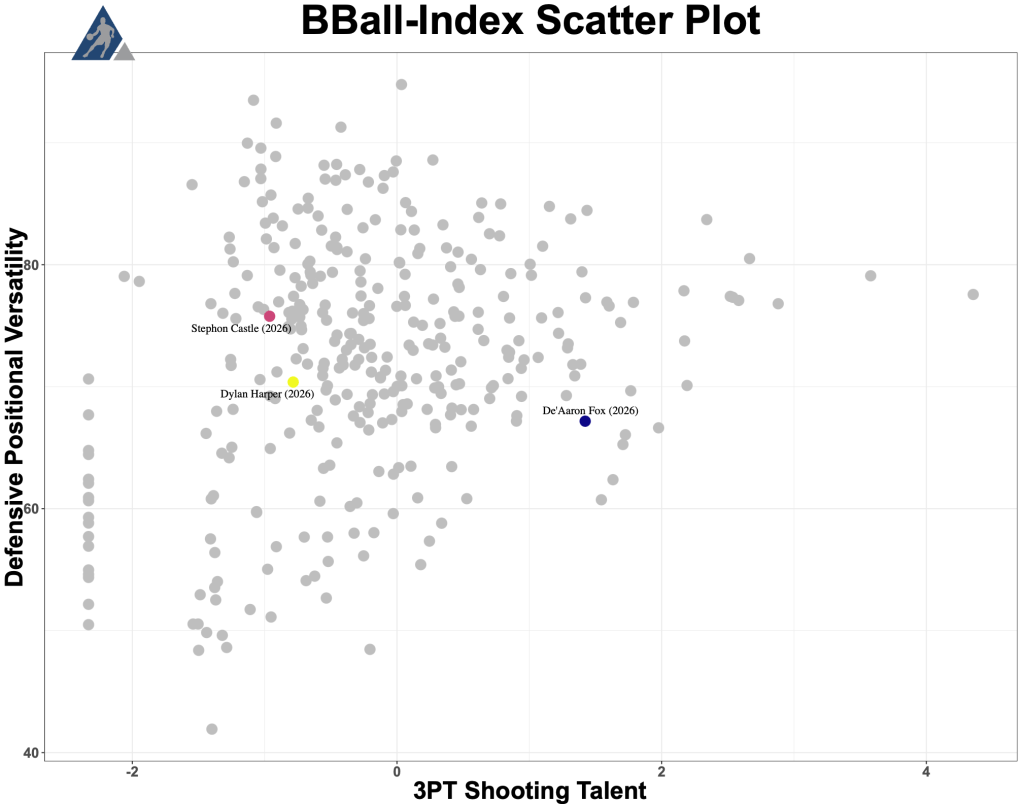
Two developments have helped: Fox’s career-best shooting from deep (38% from three), and Harper moving to the bench. Harper’s bench role (30% from three) improves shooting and defensive versatility in the starting lineup.
The lingering question is how San Antonio maximizes this guard talent long-term. Fox just signed a $229 million extension, locking him in as the presumed No. 2 option. Castle, whose defense, finishing, and playmaking are all elite, has already won Rookie of the Year and reasonably expects lead-ball-handler reps and future investment.
Castle leads the Spurs in assists (6.9), potential assists (12.4), and assist points created (18.4), all while defending the opponent’s best guard every night.
Fox and Castle can coexist if Fox’s shooting holds, but Harper’s development is the tricky part. As a No. 2 overall pick, he should be in a position to start and run an offense. Instead, he’s being asked to play as an efficient role player off the bench.
That ability flashed in the Cup Final, where he scored 21 points on 5-of-7 shooting from three – impressive, but likely unsustainable.
This awkward fit may not hurt the Spurs’ ability to win right now, but it does risk harming Harper’s long-term development. That No. 2 pick “value” might ultimately be better spent on a frontcourt partner to pair with Wembanyama.
For now, though, we get to enjoy watching three ultra-talented guards alongside the highest-potential player of our generation.
 Basketball Operations Brief
Leave a comment